

Buying Pet Food Online in the UK
A lot of dog and cat food still gets bought in a rush. Someone grabs a heavy bag on the way home, or tops up in a panic when the scoop hits the bottom of the bin. Buying pet food online fixes that, but only if you know what you are comparing. This guide covers how to choose between food types and brands, how to read a UK label properly, how to work out what a food really costs per day in pounds, and how to set up repeat deliveries so the bowl never runs empty.
Quick answer: When buying pet food online, choose the food type first, then compare brands using the label. Look for the word “complete”, a named meat near the top of the ingredients and the analytical constituents. Work out cost per day from price per kilogram and daily grams, then use subscribe-and-save so you never run out.
Key Takeaways
Check that the label says complete. Complementary foods, toppers and treats are not designed to be fed on their own.
The naming rules tell you roughly how much meat is inside. “With chicken” means at least 4%, while “chicken” in the product name means at least 26%.
Compare foods on cost per day rather than price per bag: price per kg × daily grams ÷ 1,000.
Compare protein and fat between wet and dry foods on a dry matter basis, not by the raw percentages printed on the pack.
Set repeat deliveries to arrive about a week before the bag runs out. Review the interval whenever your pet’s weight, age or activity changes.
What to Compare When Buying Pet Food Online
Start with the food type, not the brand
Online ranges are far wider than anything a high-street shelf can hold, so it helps to narrow things down before you look at brand names. For dogs, the main types are dry kibble, wet food, cold pressed, freeze-dried and semi-moist. My Pet Warehouse UK stocks all five, along with dry and wet food for cats. Each type suits a different kind of animal and household.
Dry dog food is the easiest to store, measure and portion.
Wet food is usually 75–80% moisture. That makes it appealing to fussy eaters and older animals with tender teeth, and to cats that rarely drink from a bowl.
Freeze-dried dog food is very light, concentrated and high in meat. Many households use it as a topper rather than a full meal.
Semi-moist food sits between dry and wet. It suits dogs that find hard kibble awkward to chew.
Lifestyle matters as much as nutrition. A busy household with a large Labrador in a flat in Leeds will probably find a big sack of dry food easier than daily tins. A retired couple in Norwich with an elderly cat might happily pay for single-serve pouches that stay fresh. If you are weighing up cold pressed dog food against traditional kibble, the buying principles below apply to both.
Comparing brands like for like
Once you have picked a type, compare brands within the same life stage and size category. A puppy food, an adult maintenance food and a senior food are formulated differently, and kibble for small breeds is cut smaller than kibble for large breeds. Comparing a small-breed puppy recipe with a large-breed adult one tells you nothing useful.
The dog food range includes Canagan, Eden, ORIJEN, Tribal, McAdams, Alpha Spirit, Essential and Natures Way. For cats, the cat food collection includes Thrive, Schesir, Carnilove, MORE and Natural & Delicious, among others. These brands take quite different approaches. Some are grain-free and some include grains, some are very high in meat and some are more moderate. Grain-free is a recipe choice rather than a mark of quality. Unless your vet has diagnosed a specific grain intolerance, a well-made food that includes oats or rice can be just as suitable. The right brand is the one your pet thrives on, at a daily cost you can sustain.
How to Read a UK Pet Food Label
Complete or complementary
Pet food sold in Great Britain has to follow the feed labelling rules carried over from EU law, chiefly Regulation 767/2009. These rules are enforced by local authority Trading Standards teams. The first thing they require is a description of what the product is. A complete feed contains everything a dog or cat needs when fed in the amounts shown. A complementary feed does not, and has to be fed alongside something else.
This catches more people out than you might expect. Treats are obviously complementary. However, some premium wet foods, especially certain high-meat cat tins, are also labelled complementary because they are not nutritionally balanced on their own. They make an excellent addition to a bowl but should not be the whole diet. When you are browsing online, the word usually appears in the product description or the label image, so it is worth zooming in before you add twenty-four tins to your basket. UK Pet Food, the industry’s trade body, publishes nutritional guidelines that reputable complete foods are formulated to meet.
Ingredients, naming rules and analytical constituents
Ingredients are listed in descending order of weight, so a named meat at the top is a good sign. A generic category such as “meat and animal derivatives” is perfectly legal, but it tells you less about what is actually in the bag. The product name also follows an industry labelling code:
“With chicken” means at least 4% chicken.
“Rich in” or “high in” chicken means at least 14%.
“Chicken dog food” means at least 26%.
“All chicken” means essentially 100%.
Watch the difference between fresh and dried meat. Fresh chicken is around 70% water and shrinks a great deal during cooking. Dried chicken is already concentrated, so a smaller percentage of it can contribute a similar amount of protein.
The analytical constituents panel lists protein, fat, crude fibre, crude ash and, often, moisture. To compare a wet food with a dry one, convert the figures to a dry matter basis: divide the nutrient percentage by (100 minus the moisture percentage) and multiply by 100. Here is how that works in practice:
A wet food showing 10% protein at 80% moisture is actually 50% protein on a dry matter basis.
A dry food showing 26% protein at 8% moisture works out at about 28%.
Many labels also give the energy content in kcal per 100g, and you will need that figure for the cost calculation in the next section.
Working Out the Real Cost Per Day in £
The simple formula
Price per bag is the least useful number on any product page. What matters is the cost per day. To work it out, divide the price by the weight in kilograms to get the price per kg. Then multiply that by the number of grams you feed each day and divide by 1,000. For example, a 12kg bag at £60 is £5 per kg. A dog fed 300g a day costs £1.50 a day, and the bag lasts 40 days.
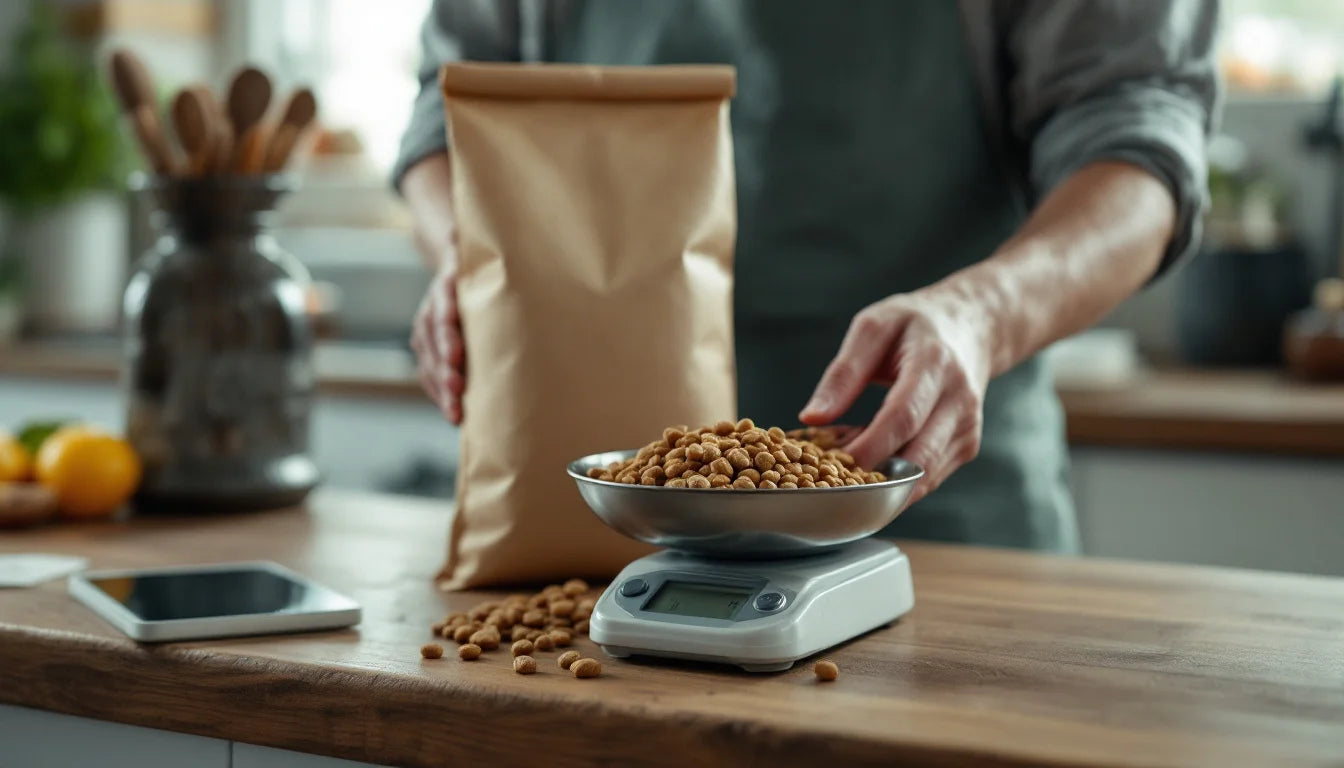
Take the daily amount from the feeding guide on the pack, based on your pet’s ideal weight rather than its current one if it is carrying a few extra pounds. Treat the guide as a starting point. The vet charity PDSA says veterinary professionals estimate that 46% of dogs and 43% of cats they see are overweight or obese, and that more than half of owners do not know their pet’s ideal weight. Portion creep is a common cause. Weighing food on a kitchen scale for a fortnight is the quickest way to see what you are really feeding. One advantage of buying pet food online is that you can compare these numbers across dozens of foods at your kitchen table, without squinting at shelf tickets.
Why the cheapest bag can cost more than you think
Energy density changes everything. A moderately active, neutered 20kg adult dog needs roughly 1,000–1,100 kcal a day, and your vet can refine that figure. Here is how two dry foods compare for that dog:
Economy food at 330 kcal per 100g and £3 per kg: about 320g a day, or around 96p a day.
Premium food at 400 kcal per 100g and £7 per kg: about 265g a day, or around £1.86 a day.
The premium food still costs more, but the gap is much narrower than the price per kilogram suggests. Larger bags of the same food usually work out cheaper per kg as well. The table below shows typical UK price ranges in 2026. These are general figures, not the prices of any particular retailer, and actual amounts depend on the food’s energy content.
Food type |
Typical price per kg |
Typical daily amount |
Typical cost per day |
|---|---|---|---|
Economy dry dog food (20kg dog) |
£2–£4 |
300–350g |
60p–£1.40 |
Premium or high-meat dry dog food (20kg dog) |
£6–£12 |
230–300g |
£1.40–£3.60 |
Cold pressed dog food (20kg dog) |
£7–£11 |
230–280g |
£1.60–£3.10 |
Complete wet dog food (20kg dog) |
£4–£8 |
900g–1.2kg |
£3.60–£9.60 |
Complete freeze-dried dog food (20kg dog) |
£35–£60 |
200–240g |
£7–£14.40 |
Complete wet cat food (4kg cat) |
£5–£10 |
200–280g |
£1–£2.80 |
Dry cat food (4kg cat) |
£6–£14 |
50–65g |
30p–91p |
Many households split the difference. They feed a good dry food as the base and add a spoonful of wet or freeze-dried food for flavour. That brings the daily cost well below an all-wet diet while keeping fussy eaters interested.
Subscribe and Save: Never Running Out
Matching the delivery interval to the bag
Running out on a Sunday evening is exactly how pets end up on an unplanned diet change. That kind of switch can upset sensitive stomachs. Repeat delivery solves the problem, and My Pet Warehouse UK offers Subscribe & Save repeat delivery on hundreds of products, so the food you have settled on arrives automatically. The skill lies in setting the right interval.
Divide the bag weight in grams by the daily amount to find how many days a bag lasts. Then set your delivery to arrive a few days before that. In the earlier example, a 12kg bag at 300g a day lasts 40 days, so a five-weekly delivery leaves a comfortable buffer. Over a year, that buffer slowly builds into a spare bag, so check whether you can move or skip a delivery when it does. For cats on wet food, count pouches or tins rather than grams. Two 85g pouches a day for one cat means 60 a month, so a monthly order of that quantity keeps things simple.
When to review your subscription
A subscription should change as your pet does. Puppies and kittens grow quickly, so the daily amount rises almost month by month until they switch to an adult recipe. Neutering typically lowers energy needs, which means the amount often needs trimming afterwards. Working dogs on farms in the Yorkshire Dales or Cumbria may eat noticeably more in winter, while a dog that does less over the dark months may need less. Holidays, a second pet joining the household or a move to a senior recipe are all good prompts to recalculate.
Freshness matters too. An opened bag of dry food is best used within about six weeks, because the fats begin to oxidise and the food loses its appeal. If you have a Chihuahua, a 12kg sack is false economy even if the price per kg looks attractive. Choose a smaller bag on a more frequent delivery. Buying pet food online on a schedule only saves money if nothing ends up stale in the cupboard.
Checking the Retailer and Storing Food Safely
Your rights when ordering online
Before you commit to regular orders, check the basics: clear UK delivery information, prices shown in pounds including VAT, a proper contact route and a written returns policy. Under the Consumer Contracts Regulations 2013, most goods bought online can be cancelled within 14 days of delivery. However, sealed goods that are unsuitable for return once opened, for health protection or hygiene reasons, can be exempt. In practice, an opened bag of food is unlikely to be returnable simply because your pet turned its nose up at it.
The Consumer Rights Act 2015 still protects you if goods arrive damaged, are not as described or are not of satisfactory quality. A split sack, dented tins or a best-before date that is unreasonably close should all be raised with the seller promptly. When a delivery arrives, check the best-before date and make a note of the batch code. Both appear on the pack and are vital if there is ever a product query or recall.
Storage once it arrives
Keep dry food in its original bag, which has a barrier lining and carries the batch details. Roll the top down and place the whole bag inside an airtight container. Store it somewhere cool and dry. Damp garages and utility rooms in older terraced houses can encourage storage mites and mould, so a kitchen cupboard is usually a better bet.
Unopened wet food is happy in a cupboard. Once it is opened, cover it, refrigerate it and use it within the time stated on the label, which is usually 24 to 48 hours. Let it come back to room temperature before serving, because cold food smells less appealing, especially to cats.
If your online order is a new food rather than a repeat, switch over gradually across seven to ten days. Mix increasing amounts of the new food into the old until the change is complete. This simple step avoids most of the digestive upsets that put people off trying a better food. It also gives buying pet food online the best chance of being a lasting improvement rather than a one-off experiment.
Frequently Asked Questions
Is buying pet food online cheaper than buying in a shop?
Often, yes. Specialist online retailers carry larger bags and a wider choice of brands, and subscribe-and-save options can lower the cost further. The fair comparison is cost per day for the same food and bag size. Factor in any delivery charge, and remember the time and fuel you save by not carrying heavy sacks home.
How much dog food should I order at once?
Order enough to last until the next delivery plus a few days’ buffer, but no more than your dog will eat within about six weeks of opening. For a 20kg dog eating 300g a day, a 12kg bag every five weeks works well. Small breeds are better served by smaller bags delivered more often.
What does “complete” mean on a pet food label?
A complete food provides all the nutrients a dog or cat needs when fed in the amounts recommended on the pack. A complementary food, such as a treat, topper or some high-meat wet foods, must be fed alongside a complete diet. Always check this wording before relying on a food as your pet’s main meal.
Can I return pet food I have bought online?
Unopened food can usually be cancelled within 14 days under the Consumer Contracts Regulations 2013. Opened food is often exempt for hygiene reasons. Damaged or faulty goods are covered by the Consumer Rights Act 2015 regardless, so contact the retailer quickly with photos, the batch code and your order number.
How do I switch my dog or cat to a new food I have ordered?
Introduce it gradually over seven to ten days. Start with about a quarter new food to three-quarters old, move to half and half, then three-quarters new, and finally the new food alone. Go more slowly for sensitive stomachs, and speak to your vet if loose stools or vomiting last more than a day or two.
Getting this right comes down to a few habits: pick the type that suits your pet and your household, read the label rather than the marketing, compare on cost per day, and let a repeat delivery take the worry away. If you would like to put that into practice, you can browse dog and cat food at My Pet Warehouse UK, compare the brands side by side and set up subscribe-and-save on the food your pet already loves.